Plug-in solar is on its way (and other energy sector news)
A couple of weeks ago, we shared some news of our own: that WeMoney had awarded GloBird Energy’s ZEROHERO plan as the Most Innovative Plan 2026. You can read all about that here.
Since we started GloBird, we’ve also done our best to share news from the energy sector that we think you’d be interested in. Some of it directly impacts consumers, some of it gives us a picture of what governments and regulators are planning, and some of it is looking ahead to what the next innovation might be. For households, that can ultimately mean better technology and more access to cheap energy.
There are always many more ideas, projects, events, and topics than we can share, so every now and then we summarise a few items in a bit of a news wrap-up… like this:
“Balcony” solar is coming
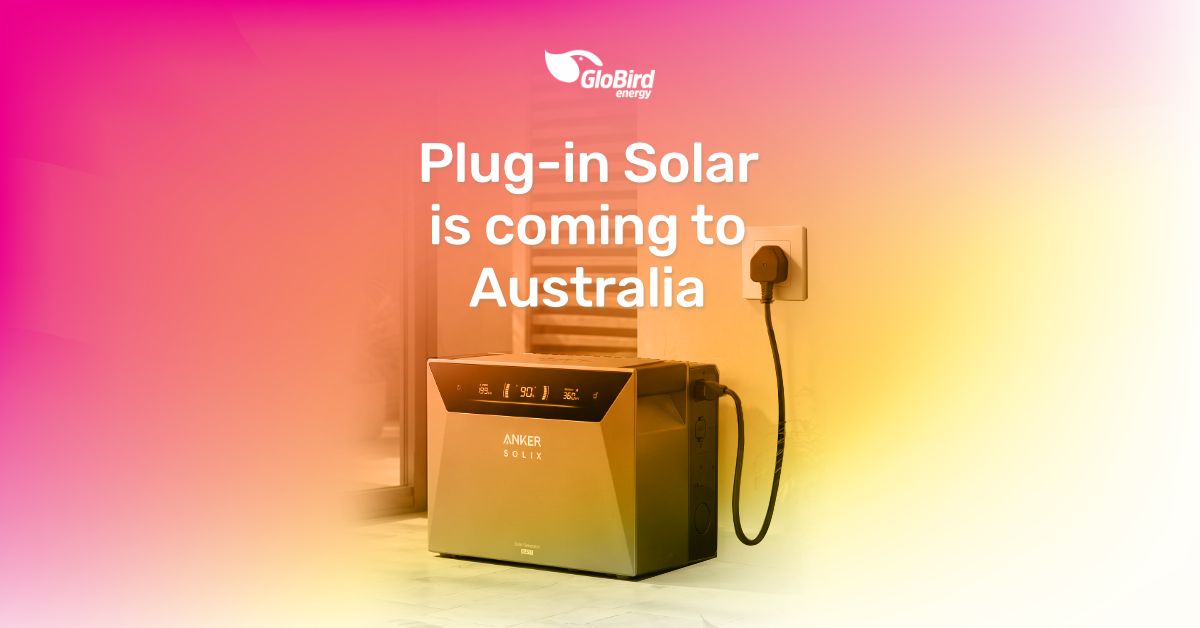
Australia’s energy ministers have agreed to explore how to legalise plug-in solar – often referred to as “balcony” solar – and batteries. This follows the UK’s move last month and New Zealand’s plan to do the same within a year. Currently, these compact systems can be sold here but not legally used, unlike Germany, where roughly one in ten households already has one.
Plug-in systems connect straight into a normal power point via an inverter, need no electrician, and typically generate 600–800 watts at a cost up to $1,300, offsetting household power use without requiring roof access.
That makes them appealing to renters and apartment dwellers, who make up over 30% of Australians. Advocates estimate savings of $300–400 a year from panels alone, potentially doubling with batteries, with payback periods of four to ten years.
Energy Minister Chris Bowen said all states and territories will work with the Commonwealth on a path forward, reporting back by year’s end. Solar Citizens, which has campaigned for the change, wants a firm timeline by December and full legalisation by next July.
Remaining hurdles include setting safety standards and getting landlords and owners corporations to permit installation on balconies or in shared spaces, an issue Germany has addressed by limiting when landlords can refuse.
Working to make solar panels cheaper, more efficient and more durable
ARENA, the Australian Renewable Energy Agency, has announced $105 million in funding for 20 solar research projects, its largest-ever single investment in solar R&D. The funding, part of the Ultra Low-Cost Solar PV Research and Development program, was expanded beyond the original $60 million after ARENA received a strong pool of applications.
The projects, mostly based at universities, aim to make solar cells and modules more efficient, durable and cost-effective, with a long-term goal of cutting the cost of large-scale solar electricity to under $20 per megawatt-hour. That matters in the long-term push for cheaper electricity.
Research directions include adapting panels for Australian conditions, using AI to identify better materials, and developing tandem solar cells that stack perovskites on silicon for greater efficiency.
UNSW’s Professor Anita Ho-Baillie, whose team is working on silicon-perovskite tandem cells, said the five years of funding would let researchers test the technology’s resistance to UV light and mechanical stress, with hopes of reaching commercial viability.
The announcement coincides with record levels of large-scale and rooftop solar investment in Australia during the June quarter, according to the Clean Energy Regulator, reinforcing ARENA’s view that Australia remains well positioned to lead in solar technology development.
The $1.5b green manufacturing hub coming to Tasmania
The Tasmanian Green Hydrogen Hub is a government-led project focused on Bell Bay, in northern Tasmania near George Town, about 50km north of Launceston.
It’s led by the Tasmanian Government alongside consortium partners TasNetworks, TasWater, Tasmanian Irrigation, TasPorts and the Bell Bay Advanced Manufacturing Zone.
Bell Bay itself is Tasmania’s largest industrial zone, spanning 2,500 hectares and exporting around 60% of the state’s manufactured products, with a deep-water port and strong wind and hydroelectric power resources. TasPorts’ $32 million ship loader upgrade has cleared its initial detailed design milestone (completion targeted for mid-2028).
The Commonwealth Government agreed in January 2024 to invest $70 million in the hub, as part of a combined investment of at least $300 million from federal and state government sources. This money is intended for improving common-user infrastructure as well as project governance and market activation support.
In May 2025, Bell Bay Powerfuels was named the provisional proponent for the hub. Construction is expected to wrap up in 2028.
Australia’s energy watchdog is on the job
The Australian Energy Regulator has knocked back Transgrid’s attempt to pass on more than a billion dollars in cost overruns from Project Energy Connect, the $3.6 billion transmission line linking South Australia and New South Wales.
In a preliminary ruling, the AER rejected Transgrid’s argument that the blowout was unforeseeable and that failing to finish the line on time would threaten grid security.
Transgrid’s portion of the project, originally budgeted at about $1.9 billion, is now expected to cost over $3 billion, following the collapse of its contract with Clough and Elecnor and setbacks including flooding, COVID-19 and inflation.
By contrast, ElectraNet completed its South Australian section on time and on budget. The regulator questioned whether these events were truly beyond Transgrid’s control and dismissed claims that delaying the project would jeopardise electricity supply.
Consumer advocate Craig Memery of the Justice and Equity Centre welcomed the decision as an important precedent, arguing it shifts financial risk back onto transmission companies rather than consumers, and calls it a “litmus test” for future major transmission projects nationwide.
Transgrid said it respected the regulator’s independence but noted this isn’t a final decision and it can still seek cost recovery in its next revenue period from 2028, and maintains the project offers major long-term benefits for consumers.
More up-to-date info now on Your Home
The government’s Your Home website has released new guidance on making homes cheaper to run and more comfortable to live in.
For more than 25 years, Your Home has been Australia’s trusted source of independent advice on designing, building, buying and renovating homes.
The resource provides expert, evidence-based guidance developed with more than 50 independent specialists.
Almost 30 new and updated pages now offer households and industry the latest advice on essential topics, including:
o minor home upgrades
o renovations and additions
o electrification
o electric vehicles
o rooftop solar
o apartment living
It was already a great resource (we’ve referenced it in several previous articles) and now it’s even better. What’s more, they’ve put all of the info into a book, if you’d like a hard copy to leaf through at your leisure (even though all the information is available for free online).
The bottom line is that the Your Home website is well worth keeping an eye on as it looks to help households save money and get more from the best energy deals.